
The global facilities management industry is set to exceed $2 trillion by 2030—but complexities are rising as fast as the opportunities. Today’s facilities are larger, more connected, and more operationally demanding than ever before.
When 70%–85% of a building’s total lifecycle costs sit in day‑to‑day operations, relying on manual processes or hindsight simply isn’t enough. Today’s facilities teams need smarter technology to stay ahead, control costs, and keep buildings performing at their best.
What Are the Core Technologies Used in Facilities Management?
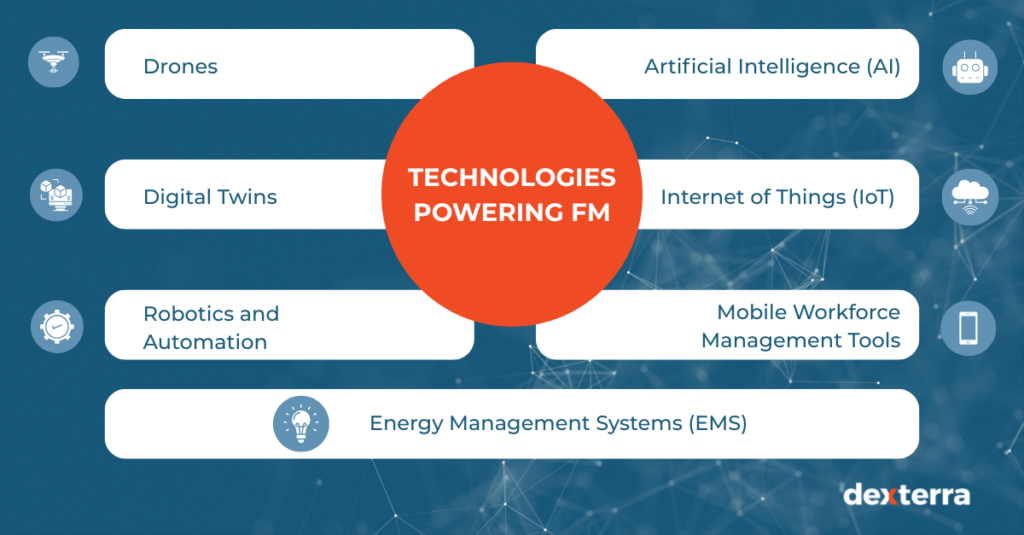
Modern facilities management relies on a set of core technologies to streamline operations and improve performance. These turn day-to-day operations into connected, intelligent workflows.
1. IoT
Imagine if a building could tell you when it was uncomfortable, inefficient, or about to fail. That’s essentially what IoT technology enables. From vibration sensors on HVAC motors to occupancy sensors in meeting rooms and air-quality monitors in hospitals, IoT gives facilities teams real-time insight into building health. Instead of waiting for complaints or breakdowns, managers get early warnings and time to act.
According to a report, approximately 35% of facility managers say IoT-driven predictive maintenance technologies have reduced downtime by more than 20%. This demonstrates how IoT directly contributes to stronger operational continuity, lower maintenance costs, and longer asset lifecycles.
2. Drones
What once felt like a nice-to-have has quickly become a must‑have in the facilities manager’s toolkit. Teams now use drones to inspect roofs, façades, and large sites in hours instead of days, all without putting anyone at risk.
Adoption is accelerating, with the global drone inspection and monitoring services market expected to reach USD 23.2 billion by 2030, driven by growing demand for building inspections and asset monitoring. By capturing high‑resolution and thermal data from hard‑to‑reach areas, drones help teams quickly spot issues like gas leaks, roof damage, and electrical faults. It helps in cutting inspection costs and keeping buildings running smoothly.
3. Artificial Intelligence (AI)
As of 2025, 28% of organizations have embedded AI solutions in their FM operations. It is quietly becoming the smartest member of the facilities team. AI notices patterns humans miss like an HVAC unit working harder than usual or meeting rooms sitting empty every Friday, and acts before issues surface. Instead of waiting for breakdowns or complaints, AI analyzes sensor data to predict failures, adjust energy use, and optimize space in real time.
4. Digital Twin Technology
Digital twin technology lets facilities teams see their buildings in an entirely new way. It creates a live, data‑driven replica of a facility by combining BIM (Building Information Modeling) models with real‑time BMS and IoT data. This gives teams clear visibility into how assets and spaces perform, not just how they were designed.
With digital twins, teams can test scenarios, troubleshoot issues remotely, and predict failures before they can cause disruption. Airports and large campuses already use them to reduce downtime, improve asset utilization, and cut energy use; with studies showing energy savings of 20% or more in modeled scenarios.
5. Energy Management Systems
The Global Energy Management Systems (EMS) market has grown to USD 40.79 billion, and it’s easy to see why. As buildings are consuming nearly 30% of global energy, facility managers are facing challenges like rising utility costs and tighter sustainability targets.
This is where EMS steps in, helping teams take control of their energy use by turning real-time data of energy use across HVAC, lighting, and other building systems and turn them into actionable insights. A Fortune Business Insights report highlights this shift, showing how analytics‑driven EMS solutions help facilities improve energy efficiency while meeting growing sustainability expectations.
6. Mobile Workforce Management Tools
Mobile workforce management tools help facility managers run tighter, more efficient operations—especially when teams are spread across sites and shifts. Instead of chasing updates or relying on paperwork orders, managers assign jobs instantly, track technician locations and task status in real time, and close work orders digitally. These tools put asset histories, checklists, safety protocols, and photos directly into technicians’ hands, reducing repeat visits and reactive firefighting.
7. Robotics & Automation
Robotics and automation are already making a visible difference in facilities cleaning across everyday environments. They quietly take over after hours and follow precise routes with controlled dispensing and consistent results. In fact, traditional techniques can result in 30% to 50% overuse of water and chemical supplies due to human error and inconsistent application.
With autonomous technologies, facilities teams can reduce waste, maintain higher standards, and shift their focus from repetitive floor work to detailing, quality checks, and enhancing the overall occupant’s experience.
Here’s a snapshot of what each core technology does and how it benefits your facilities:
| Technology | What It Does | Why You Need It |
| Internet of Things (IoT) Sensors | Collects real-time data on equipment performance, occupancy, and environmental conditions | Enables predictive maintenance and data-driven facility optimization |
| Drones | Conducts aerial inspections of roofs, façades, runways, and hard‑to‑reach assets | Improves safety, reduces inspection time and costs, and enhances asset visibility |
| Artificial Intelligence (AI) & Machine Learning | Analyzes large data sets to identify patterns and predict issues | Reduces failures, improves efficiency, and supports proactive operations |
| Digital Twins | Creates virtual replicas of physical assets or buildings | Enables scenario testing, performance optimization, and risk reduction |
| Energy Management Systems (EMS) | Tracks and optimizes energy consumption across facilities | Cuts energy costs, supports sustainability goals, and improves compliance |
| Mobile Workforce Management Tools | Enables technicians to access work orders, data, and documentation in the field | Increases productivity, improves response times, and enhances service quality |
| Robotics & Automation | Performs repetitive, labour‑intensive (cleaning), or precision‑based tasks across facilities | Boosts operational efficiency, reduces manual errors and enhances safety |
How is Tech-Enabled FM Transforming Different Industries?
Tech-enabled facilities management applies across sectors where operational efficiency, safety, and user experience are critical. This includes:
1. Airport & Transit
It was not long ago that Toronto Pearson (GTAA) piloted SITA’s AI “Total Optimizer” to dynamically prioritize performance, cost, experience, and sustainability. Today, technology is redefining airport facility management by replacing reactive operations with predictive systems that enhance overall passenger experience. According to McKinsey, airports that apply the right Infratech effectively can boost EBITDA by 6–8% within just a few years, with predictive maintenance and advanced analytics playing a major role.
2. Healthcare Facilities
In healthcare facilities, IoT‑ and ML‑driven predictive maintenance is already delivering measurable value. A hospital leveraged vibration analytics to detect failures early, reducing diagnostic equipment maintenance costs by 25%.
Technology in healthcare is making an impact beyond equipment, too. Studies show that AI models can reduce air‑quality prediction error by more than 50%, enabling hospitals to proactively adjust ventilation before issues arise. For facilities managers, this means fewer emergency interventions and smoother operations.
3. Remote Site
The remote facility management industry is set to reach $15 billion by 2033. Whether in mining, energy, or isolated infrastructure, remote sites face a unique challenge – limited access and delayed support. Technology bridges the gap. Innovations like IoT, AI, and cloud computing, are enabling smarter energy management, predictive maintenance, and more efficient resource allocation.
4. Retail Facilities
In-store retail still matters. In fact, 64% of Canadians say they value physical shopping experience. From an FM lens, the opportunity now is using technology to elevate that experience. Mall operators tapping into AI‑driven tools like footfall and dwell‑time tracking are already seeing around a 30% revenue lift, simply by fine‑tuning layouts, adjusting cleaning schedules, and managing traffic flow based on how shoppers move through the space.
5. Data centres
Data centres already consume about 1.5%–2% of the world’s electricity—and with AI accelerating demand, that figure is set to double by 2030. To stay resilient and meet sustainability goals, facilities managers are turning to smart facilities management technologies like automation and digital twins. This shift is reflected in the global DCIM market, which is growing at over 20% CAGR. These technologies help modern data centres stay efficient, reliable, and ready for the future.
What are the Key Benefits of Technology in Facilities Management?
If you’re a facility manager shaping a smarter, more resilient strategy, technology needs to be part of the plan. It gives you greater control, clearer insights, and stronger outcomes across your facilities. Here are the key benefits that make it worth the investment.
1. Predictive Maintenance
Predictive maintenance technologies help facility managers fix problems before they turn into disruptions. Sensors, IoT, and AI monitor equipment health in real time and flag early warning signs—such as unusual vibration or temperature changes, so teams can act sooner.
2. Data-Driven Decision Making
FM technology replaces guesswork with visibility. Dashboards pull data from work orders, assets, and building systems to show what’s working, what’s failing, and where money is being spent. As a result, facility managers can prioritize work, defend budgets, and plan proactively.
3. Prolonged Asset Lifespan
Condition‑based monitoring ensures assets receive the right maintenance at the right time. Instead of over‑servicing or neglecting equipment, facility teams act based on real performance data. This approach reduces wear and tear, delays capital replacements, and improves return on assets like HVAC systems, elevators, and critical infrastructure.
4. Cost Savings and Resource Optimization
Technology helps facility managers do more with less. Energy management systems reduce energy waste, automated workflows streamline labour, and digital tools eliminate inefficiencies caused by manual processes.
5. Enhanced Occupant Experience
When facilities run smoothly, occupants feel the difference. Technology supports better thermal comfort, improved air quality, faster issue resolution, and fewer disruptions. Real‑time monitoring and mobile tools allow teams to act before complaints arise improving satisfaction and reinforcing the value of facilities management as a driver of productivity and wellbeing, not just maintenance.
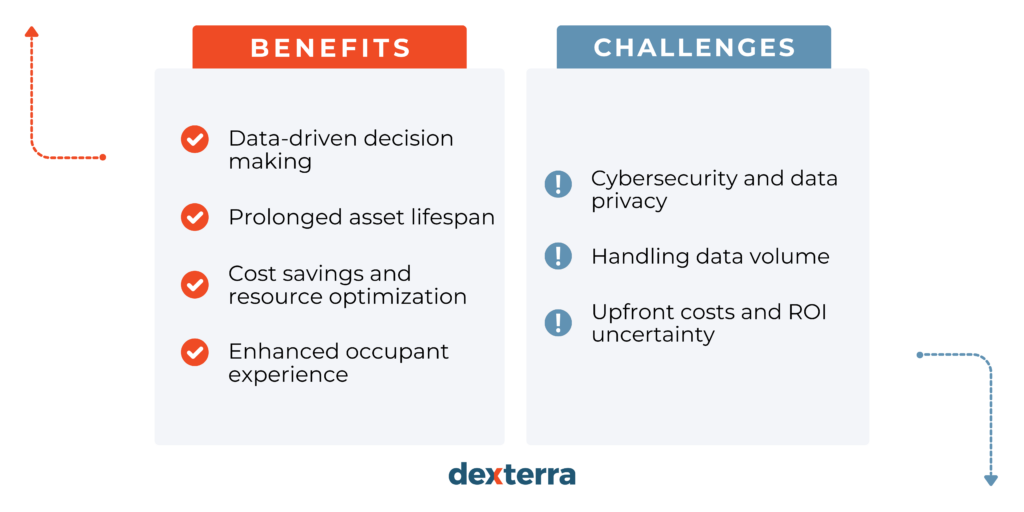
What Are the Key Challenges of Technology in Facilities Management?
While technology has transformed facilities management for the better, it also brings a new set of challenges that facility managers need to plan for.
1. Cybersecurity and Data Privacy
As facilities become more connected, they also become more exposed. Cloud platforms, IoT sensors, and smart building systems generate and share large amounts of sensitive data. Without the right controls and governance, digital convenience can quickly turn into a security risk.
2. Handling Data Volume
Modern FM technology produces a flood of data from sensors, energy systems, and occupancy tracking. The challenge isn’t collecting data; it’s making sense of it. Facility managers often struggle to turn raw data into meaningful insights without the right analytics tools or expertise. Too much data, without clarity, can overwhelm teams instead of empowering them.
3. Upfront Costs and ROI Uncertainty
Technology investments often require significant upfront costs, from software licenses to integration and training. For facility managers working with tight budgets, it can be difficult to clearly demonstrate ROI early on. The benefits, such as reduced downtime or extended asset life, are real, but they may take time to materialize. This requires stakeholder buy‑in to be an important part of the strategy.
Future of Technology in Facilities Management
Technology will continue to reshape facilities management—making it more proactive, predictive, and people‑focused. The industry is moving toward AI‑driven maintenance, smarter energy optimization, digital twins, and fully integrated FM platforms that connect assets, people, and performance in real time.
As buildings become more connected, facility managers will spend less time reacting to issues and more time planning, optimizing, and proving value.
The role of FM will increasingly shift from operational support to strategic leadership, with technology acting as the backbone for smarter decisions, sustainability goals, and better occupant experiences.
Explore how Dexterra leverages technology to deliver an integrated facilities management approach.
Frequently Asked Questions
The biggest benefit is proactive control. Technology gives facility managers real‑time visibility into assets, energy use, and operations. It helps prevent issues, reduce costs, and make data‑backed decisions instead of reacting to problems after they occur.
Technology shifts facilities management from reactive to strategic. It automates routine tasks, improves visibility across sites, extends asset life, and enhances occupant experience.
Tech-enabled facilities management enables real‑time monitoring and automated controls that enhance safety responses while reducing energy use, emissions, and waste.