
The way we work is shifting – again! After years of remote setup, many companies across the globe are bringing employees back to the office. From federal and Ontario public employees working in the office three days a week to global chains ordering a four-day-in-office policy, a structured in-office mandate is becoming the new normal.
But as we return to shared spaces, the question arises…are our workplaces truly ready? We often talk about productivity in terms of leadership, time management, and achieving KPIs. But what if the biggest influence on one’s wellbeing and productivity aren’t just these factors? What if it has more to do with the buildings themselves?
So, how do we make indoor spaces where we work, work for us?
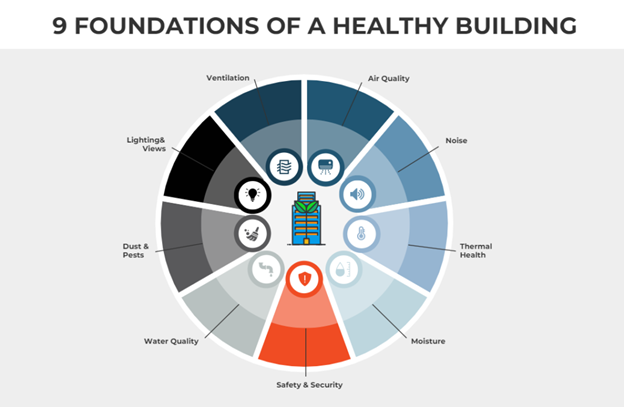
The Nine Foundations of Healthy Buildings
The key lies in the Nine Foundations of Healthy Buildings, identified by Harvard T.H. Chan School of Public Health. This framework outlines the key elements that impact how we feel and function at work and beyond. It includes ventilation, air quality, thermal health, moisture, dust and pests, noise, lighting and views, safety and security, and water quality.
Let’s walk through a typical office worker’s 9–5 workday to understand how each of these foundations contribute to a healthier, more productive workplace.
1. Morning Arrival
Foundations – Indoor Air Quality & Dust/Pests
Imagine stepping into a workspace where the lobby looks dusty, and the air feels stuffy. Such an environment is likely to hinder an employee’s progress. In fact, the Global CogFx study revealed that poor indoor air quality can lead to lower cognitive test performance at the workplace. Partnering with an integrated facility management service (IFM) is one way to resolve this issue. Utilizing a Computerized Maintenance Management System (CMMS), IFM can help you schedule, monitor your HVAC systems, and other proactive ongoing maintenance.
IFM experts can also help build a healthy indoor environment by increasing ventilation, improving air flow, and integrating air disinfection solutions. Keeping seasonal changes in mind, they can also provide air supply solutions during both hot and cold weather conditions.
In a workplace, dust and pest control are equally critical. When buildings are poorly managed, they are often prone to infestations which can eventually cause Sick Building Syndrome. With an IFM partner, you can assess vulnerabilities and create a pest control plan. One that reduces health risks and creates a safe and healthy workplace.
2. Settling In
Foundations – Ventilation / Moisture
As employees settle at their desks, the behind-the-scenes operations of HVAC systems come into play. A well-designed HVAC system helps circulate fresh air, dilute indoor pollutants, and maintain healthy indoor humidity levels. Research has shown that lower ventilation rates can lead to slower response times and reduced accuracy on a series of cognitive tests.
With the help of an experienced facility management service provider, you can ensure that your ventilation systems operate properly and provide acceptable IAQ for the current occupancy level for each space.
Moisture control is yet another factor that plays a vital role in how comfortable and healthy a workplace feels. Excessive humid environments can promote mold growth, while overly dry conditions can irritate the skin and respiratory systems. By maintaining balanced humidity (ideally between 30-60%), you can create a safe, comfortable, and focused workplace.
3. Focus Mode
Foundations – Noise
As the day progresses, employees dive into their work mode – whether it is coding, analyzing or strategic planning. But ambient noise from the streets, office equipment, or HVAC systems can distract even the most concentrated minds. A Jabra survey found that 74% of workers said loud work environments make them mentally tired.
Here’s where IFM can play a meaningful role. Measures like improving office layouts, conducting regular noise audits and creating quiet zones can help create a productive work environment.
4. Afternoon Slump
Foundations – Light & View
After lunch, many employees tend to experience a decrease in their energy levels. This is often associated with sugar levels and circadian rhythms. However, factors like natural light and hydration play a vital role. According to a study, employees seated near a window get 46 more minutes of sleep per night and report better daytime alertness. It is due to the power of natural light, which boosts serotonin levels and energizes the body.
IFM providers can develop a layout design that maximizes natural light. They can help you identify opportunities in using reflective surfaces, optimizing window placement, adding elements like living walls, and installing lighting controls.
5. End of the Day
Foundations – Safety & security
The role of a well-managed building goes beyond offering operational efficiency. As employees wrap up their day, they look for a sense of security and safety. Be it access to control systems, emergency protocols, or secure lighting in parking areas; these safety factors foster peace of mind.
Whether it’s developing evacuation procedures in case of security incidents or plans for equipment failures within the workspace, IFM providers can customize plans to your building’s specific needs.
Round the clock
Foundations – Water quality & Thermal Health
Some foundations of a healthy building impact employee productivity around the clock. Two examples are water quality and thermal health. They work silently in the background throughout the day, supporting safe and healthy workplaces.
When it comes to water quality, cleanliness, safety, and accessibility are some of the non-negotiable factors for a healthy building. Through regular testing, maintenance of plumbing systems, and filtration solutions, an IFM provider can ensure that the water at your workplace meets safety standards. They also use digital tools to track quality metrics and spot potential risks. This results in fewer disruptions and healthier employees who can rely on safe drinking water throughout the day.
In terms of thermal health, IFM experts use smart building technologies to offer strategies based on real-time occupancy and external weather changes. It includes seasonal adjustments, individualized temperature zones, and calibration of thermostats. Keeping these factors in check helps in prioritizing the well-being of your employees.
Rethink Productivity Inside Out
Investing in a safe and healthy workspace goes beyond enhancing infrastructure. It is about creating spaces where your employees can thrive every single day.
Learn more about our IFM approach.